Saturday, 10 September 2016

Lurching from one mistake to another

Daily Draw: Ship of Fools Tarot, King of Coins.

The image here is of Midas complete with ass's ears praying for his golden touch to be revoked. It is somewhat anachronistic as legend has it the ears arrived after he had learned his first lesson. 

With hands back to normal, Midas turned his back on wealth and splendour, relocated to the country and became a follower of Pan, the god of the fields and satyr. 

One day Pan had the audacity to challenge Apollo to the ancient version of an X Factor sing off. Pan insisted that his little reed flute could make more beautiful melody than Apollo's harp. The two agreed to a contest complete with judging panel which included KM. 

After hearing both performances all but one judge (Midas) hailed Apollo as the winner. There are different versions of the exchange that followed. In the first Apollo whispered gently, 'I see the problem. It's your ears. They are too small to hear properly. Let me fix that for you.' In version two he was more succinct: 'Must have the ears of an ass'. Either way the outcome was the same... 
King Midas felt his ears quiver. His ears sprang out and turned into the large hairy ears of an ass. Mortified he grabbed his ears crying. 'Pan, help me!' he cried. But Pan, with one eye on Apollo, turned his back. 
King Midas tried to hide his ears by wearing an impressive variety of hats, helmets and headdresses. The only person who knew his secret was his barber who was sworn to secrecy. 
The barber kept his word (at first). But the burden of the secret began to wear him down. Eventually he dug a hole in the midst of some reeds and whispered into it 'King Midas has the ears of an ass. King's aaaass ears! King's aaaass ears!' 
Alas, for King Midas, the barber had dug into a piece of echo who ever after whispered over and over, 'King's aaaass ears, king's aaaass ears'.
Before long the whole kingdom knew Midas's secret. 
There's a lesson in there about overcompensating for one mistake and in so doing making another. 

Friday, 9 September 2016

Seven Sins to Ten Commandments

Daily Draw, Ship of Fools Tarot, Four of Cups

The image of a sleepy fool about to receive a rude awakening has been adapted from a Narrenschiff image that satirises sloth. In the middle ages through to the fifteenth century the chief vehicle of the moral tradition in the West was the doctrine of the seven deadly sins. In order of severity: pride, envy, anger, avarice, gluttony, sloth and lechery. 

They were often divided into sins of the spirit and sins of the flesh with the former to be avoided more than the latter. Pride, envy and anger were in the first category and gluttony, lechery and usually sloth in the second. Avarice could be one or the other. 

According to John Bossy they formed a system of community ethics making more excuse for sins of concupiscence that for those of aversion. The reasoning being that sins of aversion destroy community but without some dalliance with the sins of concupiscence there is unlikely to be a community at all. 

This doctrine of sin expounded by parsons, friars and town preachers is expressed by the parson in Chaucer's Canterbury Tales. For him pride, envy and wrath came first. Pride being a social phenomenon which consisted of putting claims of status before those of sociability. 

Envy had two main forms - jealousy of other men's prosperity and pleasure in their misfortune. It implied the doctrine of limited good - the idea that there is a finite amount of good fortune in the world so that what accrues to one member of a community must be taken from the rest. The parson thought it the worst of all sins because it was the most directly opposed to solidarity and charity (meaning love of God and one's neighbour) and the root of much backbiting and discord. 

Rather than denoting bad temper, wrath meant a longstanding firm hatred of a neighbour expressed in acts of malice or vengeance against him. This included manslaughter, cursing, swearing and verbal abuse but also usury, the withholding of wages and alms, witchcraft, conjuring and divination.

The fifteenth century witnessed the Church sanctioned transition from the seven deadly sins to the Ten Commandments as the principle moral system. The results were nothing short of revolutionary. 

Henceforth sins against community previously regulated by private arrangement were replaced with punishable sins against God, the State and the Church. In the new order a drive for chastity, respect for authority and property were to supersede the medieval concern for charity.  

Source: Bossy, J. (1985) Christianity in the West, Oxford: Oxford University Press. 

Wednesday, 7 September 2016

An honest trade

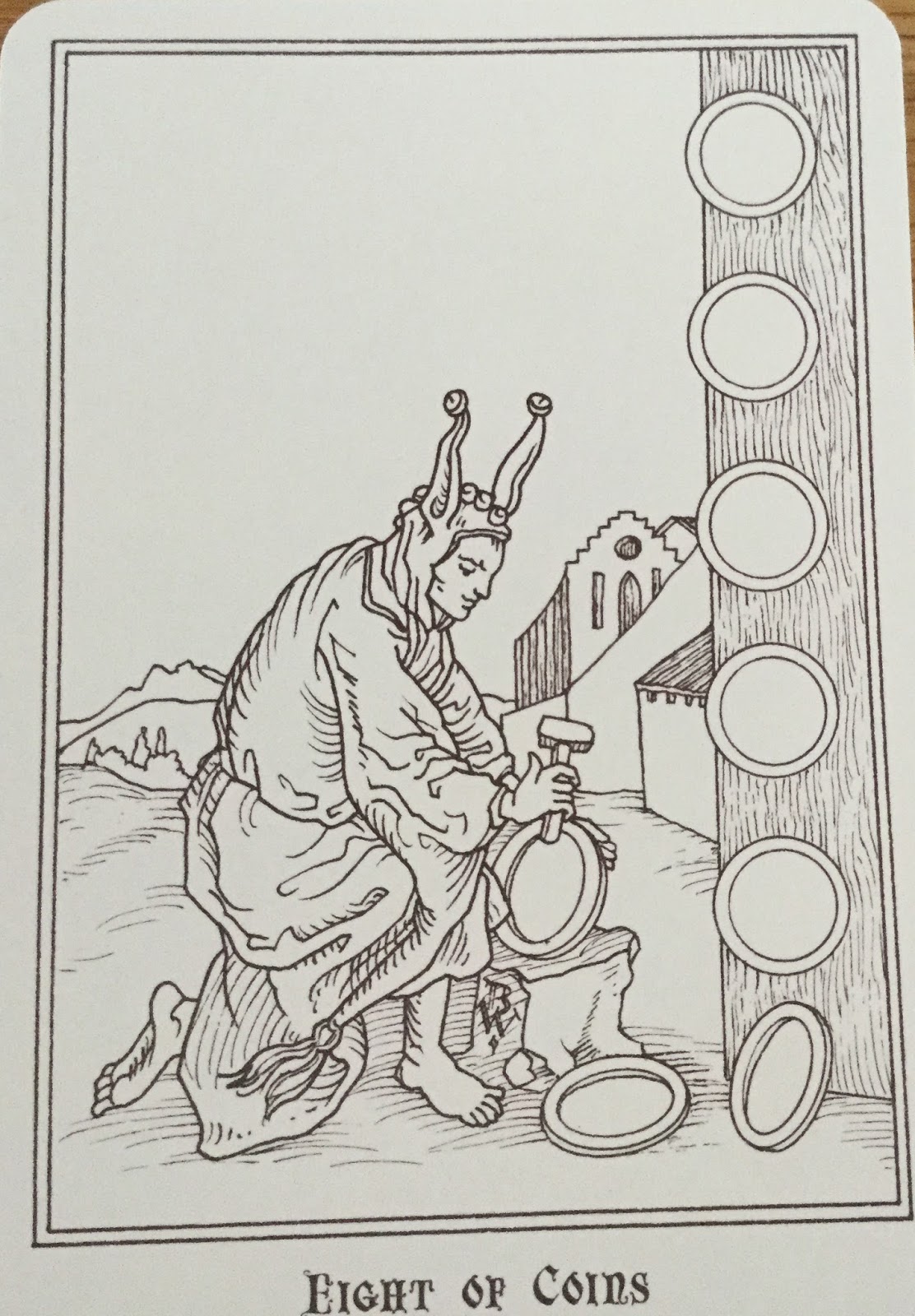
Daily Draw: Ship of Fools Tarot, Eight of Coins

Whether or not you're interested in religion the Oxford Dictionary of Saints has value in showing the sheer abundance of historical crafts and trades. 

There is St Honore patron saint of pastry chefs; Saint Crispin and Crispinian, patron saints of cobblers, curriers, tanners and leather workers; St Andrew patron saint of fishmongers (as well as sore throats and old maids) St Agatha patron saint of bakers, bell-makers and nurses; St Ambrose of Milan, patron saint of bee keepers, candle makers, wax melters and refiners; Erasmus of Formiae, patron saint of pyrotechnicians, steeplejacks, chimney sweeps and anyone who works at great heights.

Eligius was a particularly hardworking saint covering metal workers, jewellers, mechanics, farriers, harness makers, vets, farmers and numismatists (those who study coins). 

Peter the Apostle also had a broad remit protecting popes, fishermen, fishmongers, sailors, bakers, harvesters, butchers, glass makers, carpenters, shoemakers, clockmakers, blacksmiths, potters, bridge builders, potters and cloth makers. Venerius the Hermit was more of a niche saint focusing only on lighthouse keepers. 

Unsurprisingly Gabriel is the saint of communications workers, postal workers, broadcasters and messengers. St Genesius' role call of trades made me smile - actors, comedians, dancers and theatrical performers of all kinds are grouped together with attorneys and barristers. 

Alas I can't identify a saint of diarists (and therefore bloggers) although I have found Catherine of Bologna, patron saint of artists, Agabus, patron saint of fortune tellers and Francis de Sales, the patron saint of writers. 

One of the disadvantages of the current emphasis on university education is that it devalues young people who want to get to work straight away as apprentices learning a craft or trade on the job. But there's a dignity in wanting to be a great baker, beautician, builder.or bookbinder as well as in passing on those skills to the next generation. I suspect that the results of such efforts make a greater contribution to human happiness than a whole heap of paper qualifications. 


Tuesday, 6 September 2016

Stalking cards and penny drop moments

Daily Draw: Ship of Fools Tarot, Knight of Staves/Wands

Of all the courts I seem to get the Knight and King of Wands most often. Not sure why and not sure I know who or what they mean. According to Brian Williams this knight can denote a traveller especially one who withdraws or departs. First thought isn't that all travellers? Second thought actually travelling can be about arrivals. This reminds me that cards wise I am still on 'a journey' .

I did have a penny drop moment when reading through the Book of Fools this week. The High Priestess card (which I have previously struggled with) can be seen as the conceptual and meditative aspect of the feminine principle as compared with the active Empress. Now there is a personal connection as I am definitely more theorist than activist. Representative of unwritten histories? Like that too. As Minerva/Athena she is Goddess of wisdom arts, crafts and more. Known for her calm temperament she will only fight for just causes. 

Best of all as Williams observes the idea of a Tarot Papess is heretical and likely to agitate the powers that be. I'm starting to like her a lot...


Monday, 5 September 2016

Movement of Music

Daily Draw: Ship of Fools Tarot, Ten of Cups

Prior to the development of systems of notation, music travelled slowly in the middle ages. Songs and instrumentals had to be learned 'by ear', from one person who knew a song to another person. This limited the geographical spread of music and explains why the role of troubadour was synonymous with traveller. 

Troubadours were often clergy educated inventors of poetry and song. While the troubadours enjoyed a certain status their assistants, the illiterate and itinerant jongleurs were deemed to be untrustworthy vagabonds. Their repertoire included various acts including, acrobatics, conjuring, dancing and juggling. 

The clergy were eventually to associate the jongleurs with such dubious 'professions' as prostitution. Henceforth they were subject to certain theologically instituted legal restrictions including refusal of the eucharist on account of putting their bodies to unlawful use. 

Later in the medieval period the foundations of notational and theoretical practices were laid enabling composers and musicians to set out their songs on paper. This made it possible for songs to reach a wider audience. Music could now travel on paper rather than in person. 


Sunday, 4 September 2016

A jar of moonbeams

Daily Draw, Ship of Fools Tarot, The Mountebank

From the Italian montambanco (quack who mounts a bench to hawk his wares) contracted from 'Monta in banco' (mount on bench). 

According to the character John Bull 'there is no nothing so impossible in Nature but mountebanks will undertake; nothing so incredible but they will affirm'. 

Reminds me of the modern day beauty companies. How do they get away with their claims? Check the small print and it will say a study of 20 women confirmed...

The latest lark is caviar face cream with a price tag of £300. According to the beauty editors it does work (a bit) and (how marvellous) doesn't smell fishy (surely that's a basic requirement not a bonus?). 

Only thing is it is perfectly possible to produce the same stuff with an RRP of £6.99. Available from a well known German owned budget store. 

Are you allowing yourself to be fooled by this mountebank, this harlequin? Do you cringe before a religion compounded of clouds and moonbeams. 

Isaac Asimov, 1920-1992

Friday, 2 September 2016

Competing wands

Daily Draw: Golden Tarot, Two of Wands


The choice card. Kat Black writes that there is a sense of dissatisfaction and yearning in this card. The merchant holding unfulfilled dreams in his hand. 

The discarded 'idea' on the wall reminds me that teaching and research are competing wands in my institution when they should be complementary. 

I came into this profession because I wanted to be a 'merchant of ideas'. Without research I have nothing to 'sell' but second hand junk. Time to pick up that wand. 


In the case of sociology however, we are always walking on hot coals, and the things we discuss are alive, they're not dead and buried.

Pierre Bourdieu, 1930-2002